


The Impact of ERP Software on Manufacturing Process Improvement
Manufacturing companies today operate in a fast-paced environment where accuracy, speed, and efficiency determine success. However, many manufacturers—especially MSMEs—still depend heavily on manual processes, spreadsheets, paperwork, and disconnected systems. These outdated workflows slow down production, create operational bottlenecks, increase errors, and make it difficult to scale.
The Good News: Modern ERP Software for Manufacturing solves these challenges by automating processes, centralizing data, improving visibility, and enabling smarter decision-making and platforms like ECERP are built specifically to help Manufacturing and MSME businesses eliminate manual chaos and run with complete control.
This blog explains how ERP systems replace manual processes, reduce inefficiencies, and transform your manufacturing operations into a smooth, predictable, and scalable ecosystem.
Why Manual Processes Fail Manufacturing Companies
Before exploring the solution, it’s important to understand why manual operations don’t work in today’s environment.
Manufacturers relying on manual processes often face:
- Inaccurate data from spreadsheets and manual entries
- Paper-based approvals causing production delays
- Lack of visibility across materials, stock, and production
- Difficulty tracking orders, purchases, and deliveries
- No real-time insight to make quick decisions
- Human errors in production plans and inventory
- Miscommunication between departments
- Poor traceability of raw materials and batch-wise production
- Uncontrolled costs due to wrong planning or purchasing
These challenges create daily firefighting and prevent teams from focusing on growth. This is where ERP Software becomes a game-changing solution.
How ERP Software Solves the Manual Process Problems in Manufacturing
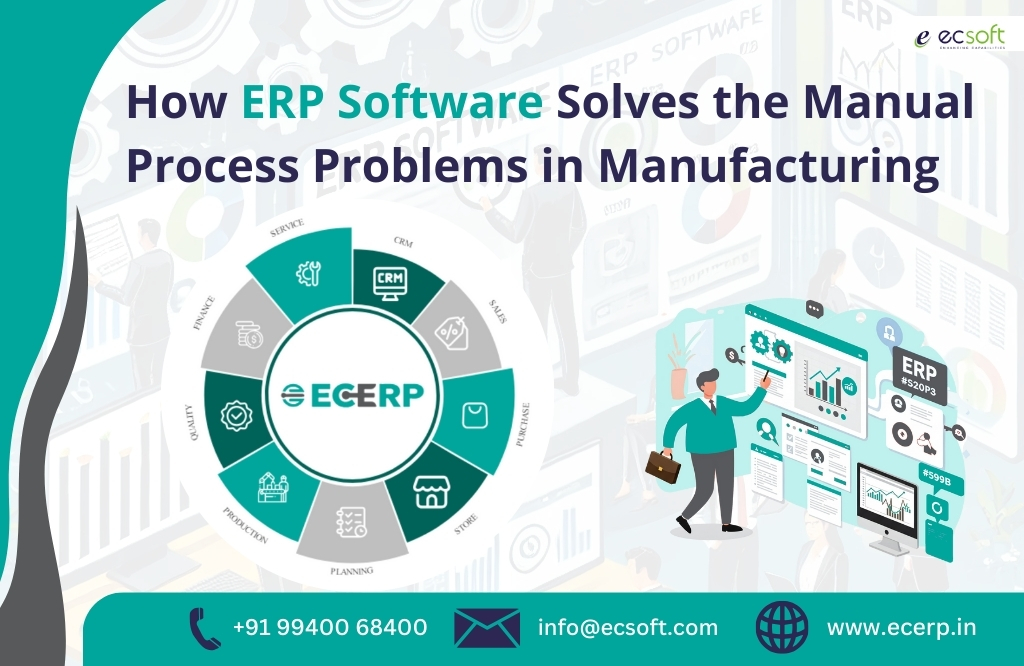
ERP software connects every department—Purchase, Stores, Production, Quality, Sales, Service, and Finance—into one Centralized ERP System. This eliminates manual work, reduces human error, and ensures the manufacturing business runs with consistent accuracy and speed. Below are the biggest manual process problems manufacturers face — and how ERP solves them completely.
1. Manual Data Entry & Spreadsheet Dependency
Problem:
Manufacturers often rely on Excel sheets and manual entries to track orders, materials, and production. This leads to:
- Data duplication
- Wrong entries
- Missing information
- Outdated data
How ERP Solves It:
ERP automates data entry, integrates all modules, and provides real-time data updates, ensuring accuracy and eliminating spreadsheet chaos.
With ECERP:
You get centralized dashboards, automated updates, and real-time visibility across all departments.
2. Lack of Visibility Across Inventory & Material Movement
Problem:
Manual tracking makes it difficult to know exact stock levels, leading to:
- Overstocking
- Stockouts
- Interrupted production
- Emergency purchases
How ERP Solves It:
ERP offers real-time inventory tracking, material movement logs, reorder alerts, and batch/lot-wise traceability.
With ECERP:
You always know what’s in stock, what’s moving fast, and what’s pending—making planning easy and cost-effective.
3. Manual Production Planning & Scheduling Errors
Problem:
When planning is done manually, it’s difficult to coordinate materials, machines, and manpower. Common issues include:
- Wrong production schedules
- Idle machines
- Material shortages
- Delayed deliveries
How ERP Solves It:
ERP automates Material Requirement Planning (MRP) and production scheduling, ensuring accurate planning and faster turnaround times.
With ECERP:
Ensures every production job is backed by proper material availability, machine capacity, and timeline.
4. Poor Communication Between Departments
Problem:
Manual communication leads to:
- Delayed approvals
- Miscommunication
- Production hold-ups
- Errors in purchase, production, or dispatch
How ERP Solves It:
ERP connects all departments into a single system, enabling instant communication, automated workflows, and live updates.
With ECERP:
Eliminates departmental silos by syncing Purchase, Stores, Production, Quality, and Sales—so everyone works with the same real-time data.
5. No Real-Time Reporting or Business Insights
Problem:
Manual reporting is slow, incomplete, and unreliable. Decision-making becomes reactive instead of proactive.
How ERP Solves It:
ERP provides real-time dashboards, analytical reports, and KPIs that help manufacturers make data-driven decisions.
With ECERP:
Offers detailed reports on inventory, production, purchases, sales, costing, wastage, and profitability.
6. Difficulty Managing Quality & Traceability
Problem:
Manual QC tracking makes it hard to trace defects, evaluate supplier quality, or manage batch-wise tracking.
How ERP Solves It:
ERP includes end-to-end quality control:
- Incoming QC
- In-process QC
- Final QC
- Supplier QC history
With ECERP:
Ensures full item-level and batch-level traceability from raw material to finished goods.
7. Approval Delays Due to Paperwork & Manual Follow-Ups
Problem:
Paper-based approvals slow down:
- Purchase orders
- Production jobs
- QC processes
- Dispatch approvals
How ERP Solves It:
ERP provides automated approval workflows, reducing delays and ensuring accountability.
With ECERP:
Managers receive instant alerts and can approve actions from anywhere.
8. Slow and Error-Prone Order Processing
Problem:
Manual entries lead to missing orders, wrong item details, or shipment delays.
How ERP Solves It:
ERP automates end-to-end order management—quotation, sales order, production, and dispatch—ensuring 100% accuracy and faster delivery.
With ECERP:
Managers receive instant alerts and can approve actions from anywhere.
The Real Business Impact of Using ERP Software
Manufacturing companies that switch from manual processes to ERP experience:
- 40% reduction in manual work
- 60% improvement in production planning accuracy
- 30% reduction in inventory costs
- 25–40% improvement in on-time delivery
- 100% data accuracy
- Faster decision-making
- Higher customer satisfaction
ERP is not a tool — it’s a strategic investment that transforms your entire manufacturing ecosystem.
How ECERP Helps Manufacturers Eliminate Manual Process Challenges
ECERP is designed specifically for Manufacturers and MSMEs to:
- Automate end-to-end operations
- Improve supply chain visibility
- Enhance production accuracy
- Reduce operational costs
- Boost productivity
- Ensure data accuracy
- Speed up decision-making
- Scale operations effortlessly
With 20+ years of manufacturing experience, ECERP brings deep domain understanding, powerful automation, and industry-specific workflows that solve real-world challenges.
Final Thoughts: Switch from Manual Chaos to Automated Excellence
Manufacturers who continue using manual processes face delays, errors, inefficiencies, and rising operational costs. But manufacturers who adopt ERP Software—especially a specialized solution like ECERP—experience predictable, fast, and efficient operations.
If you want to grow faster, eliminate manual bottlenecks, and build a strong manufacturing system, ERP is the most powerful decision you can make.