


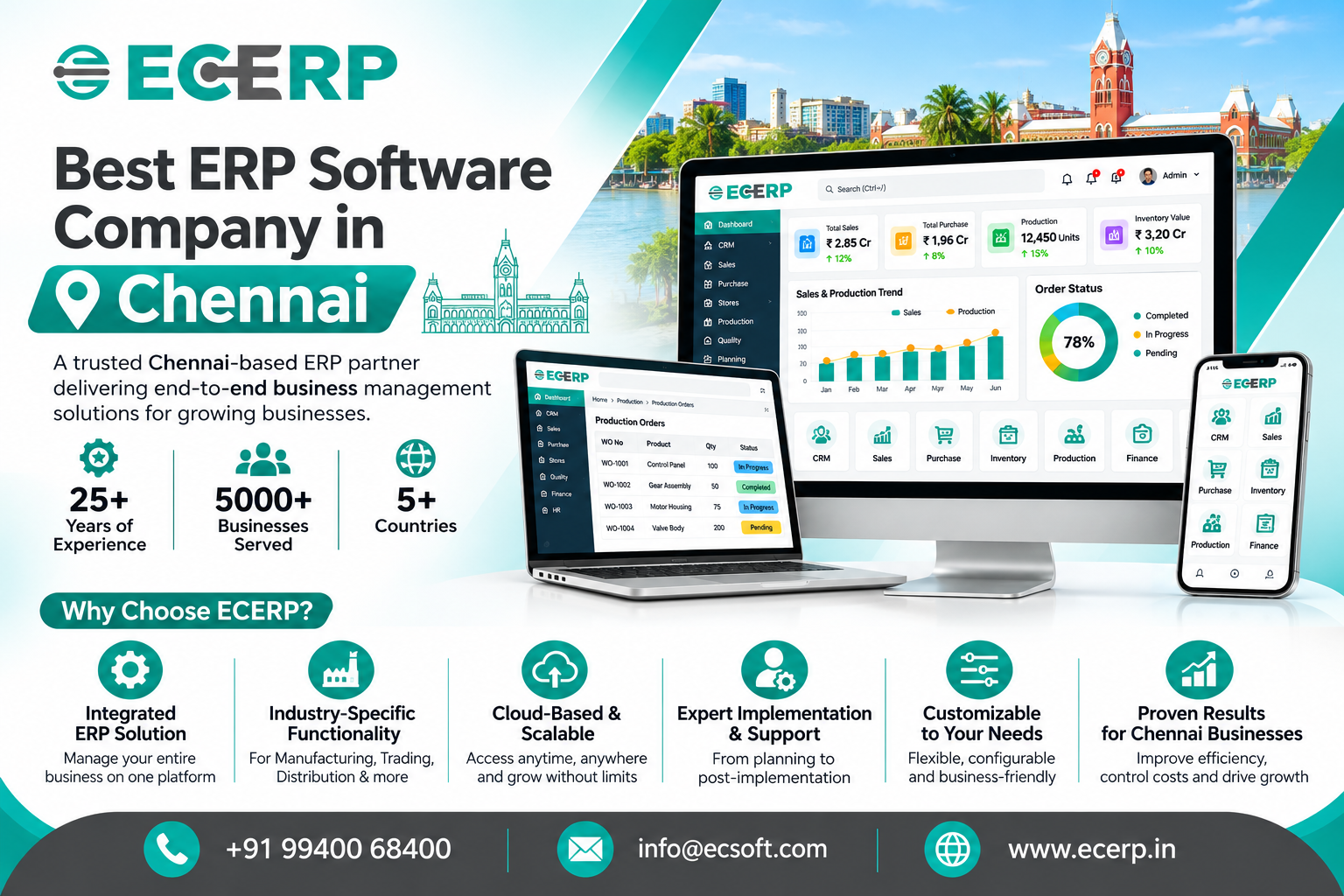
Best ERP Software Solutions for Businesses in Chennai
Choosing ERP software can change the way a business operates. From managing customer relationships and sales to controlling inventory, production, finance and employee activities, businesses need a reliable system that keeps every department connected.
As companies expand, managing operations through spreadsheets, separate applications and manual processes becomes increasingly difficult. Information gets scattered, departments work independently, stock discrepancies occur and management often struggles to get a clear picture of overall business performance.
This is why more businesses are exploring integrated ERP software solutions to bring their operations together.
If you are searching for the best ERP software company in Chennai, the important question is not simply which company offers the most features. It is which ERP software provider understands your business requirements, offers the right functional modules and can support your organisation throughout its digital transformation journey.
Chennai has a growing ecosystem of manufacturing companies, automotive businesses, engineering firms, distributors, traders, retailers and service organisations. Each has different operational requirements, making the selection of an appropriate ERP solution an important business decision.
ECERP, developed by ECSOFT PRIVATE LIMITED, offers integrated Enterprise Resource Planning software designed to help businesses manage their operations through a unified platform. With 25+ years of software experience, ECSOFT focuses on delivering practical business software solutions that help organisations improve operational coordination, productivity and business visibility.
In this guide, we will explore what makes a good ERP software company, the essential ERP modules businesses should consider, how to evaluate ERP providers and how ECERP can support different business requirements.
Why Are Businesses in Chennai Looking for ERP Software?
Running a growing business involves coordinating several departments, employees, suppliers, customers and operational activities.
Initially, spreadsheets and standalone applications may be sufficient. However, as transaction volumes increase and business operations become more complex, these methods can create unnecessary complications.
Consider a company that manages sales, purchases, inventory, production and finance using different applications. The sales department may have one set of customer records, the purchase department may maintain separate supplier information and the stores department may update stock manually.
When these systems are disconnected, obtaining accurate information becomes difficult.
An integrated ERP system connects essential business functions and provides a more organised way to manage operations.
Here are some common reasons businesses are investing in ERP software in Chennai.
1. Managing Multiple Departments from Different Systems
When departments use separate applications, sharing information and coordinating activities can become complicated.
ERP software connects relevant departments through a common platform, helping employees access information according to their roles and permissions.
2. Inventory and Stock Management Challenges
Businesses dealing with multiple products, warehouses and stock movements need accurate inventory information.
An ERP system helps organise stock records, monitor inventory movements and coordinate purchasing with sales and operational requirements.
3. Increasing Manual Work and Data Entry
Repeated data entry consumes employee time and increases the possibility of errors.
Integrated ERP workflows help reduce repetitive activities and improve the flow of information between departments.
4. Limited Business Performance Visibility
Business owners and managers need timely information to understand sales performance, purchasing activities, operational expenses and overall business progress.
ERP reporting and dashboards help bring relevant information together for better management visibility.
5. Difficulty Managing Business Growth
As businesses expand, they need systems that can support additional users, departments, products, warehouses and operational requirements.
A scalable ERP solution provides a structured foundation for managing this growth.
6. Production and Resource Planning Difficulties
Manufacturing businesses must coordinate materials, production schedules, work orders, resources and quality inspections.
ERP software helps organise these activities and improves coordination across the manufacturing process.
How to Choose the Best ERP Software Company in Chennai?
Finding the right ERP software company in Chennai requires more than comparing prices or looking at product demonstrations.
The ERP provider you select should understand your business operations and offer a solution that can support both current and future requirements.
Before making a decision, evaluate the following factors.
1. Complete ERP Software Modules
A good ERP solution should provide the modules required to manage your organisation's major business activities.
Depending on your industry, these may include:
- Customer Relationship Management (CRM)
- Purchase Management
- Inventory and Stores Management
- Planning Management
- Production Management
- Quality Management
- Sales Management
- Finance Management
- Asset Management
- Human Resource and Payroll Management
- Design Management
- Project Management
- Maintenance Management
Check whether the modules are integrated and whether information can flow between the relevant departments.
2. Industry-Specific Business Understanding
A manufacturing company does not operate in the same way as a distribution company or a service organisation.
Manufacturers may require production planning, BOM management, quality inspection and material tracking. Distributors may prioritise purchasing, warehouse management, sales orders and inventory control.
Choose an ERP software provider that can understand these differences and configure the solution according to your business processes.
3. Customisation and Configuration
Every organisation has its own business workflows, approval processes and reporting requirements.
Your ERP software should offer suitable configuration and customisation options to accommodate these requirements.
Before selecting an ERP software development company in Chennai, discuss your actual workflows and understand how the software can support them.
4. Cloud Accessibility and Scalability
Modern businesses increasingly need access to operational information from different locations.
When evaluating cloud ERP software in Chennai, check the availability of remote access, user permissions, data backup, security arrangements, system performance and scalability.
The solution should support your business requirements without making everyday operations unnecessarily complicated.
5. Implementation and Technical Support
ERP implementation is a business transformation activity, not simply a software installation.
The provider should understand your existing processes, identify implementation requirements, configure relevant modules, assist with data preparation and provide employee training.
Also understand what technical support and maintenance arrangements are available after implementation.
6. Product Demonstration and Practical Evaluation
A product demonstration helps you understand whether the ERP system can support your actual requirements.
Rather than watching only a general presentation, ask the provider to demonstrate relevant workflows such as:
- Creating a purchase order.
- Recording inventory transactions.
- Processing a sales order.
- Managing production activities.
- Tracking project progress.
- Viewing financial information.
- Managing employee and payroll records.
A practical demonstration gives you a better understanding of how the system will work in your organisation.
ECERP – Integrated ERP Software Company in Chennai for Complete Business Management
When businesses search for ERP software solutions in Chennai, they need a platform that can connect their essential operations rather than simply digitise individual activities.
ECERP is an integrated Enterprise Resource Planning solution developed by ECSOFT PRIVATE LIMITED to help businesses organise and manage their operations through dedicated business modules.
With 25+ years of software experience, ECSOFT has been developing business software solutions to support organisations across different industries.
ECERP brings together essential business functions, helping companies manage customer relationships, procurement, inventory, planning, production, quality, sales, finance, assets, employees, designs, projects and maintenance.
Instead of managing every department through disconnected applications, businesses can explore an integrated approach to managing their daily activities.
What Makes ECERP Worth Considering?
- Integrated ERP platform: Connect multiple business functions through a unified system.
- Comprehensive functional modules: Explore dedicated modules for different business operations.
- Industry-oriented capabilities: Support different operational requirements across manufacturing, trading, distribution and service businesses.
- Configurable business processes: Adapt relevant workflows to suit organisational requirements.
- Improved information visibility: Bring business information together for better coordination and reporting.
- Implementation assistance: Get support in understanding and implementing relevant ERP modules.
- Software development experience: Benefit from ECSOFT's 25+ years of software industry experience.
Explore 13 Essential ECERP Modules for Complete Business Management
One of the important considerations when selecting ERP software is understanding what each module contributes to your business.
ECERP brings together the following functional areas to help businesses manage different operations through an integrated ERP environment.
1. CRM Management – Build Better Customer Relationships
Customer relationships play an important role in business growth. Managing customer details, enquiries, quotations and sales follow-ups through disconnected systems can make it difficult for sales teams to maintain consistent communication.
ECERP's CRM module helps organise customer-related information and pre-sales activities.
Businesses can use CRM capabilities to manage:
- Lead and prospect information.
- Customer and contact records.
- Sales enquiries.
- Quotations.
- Sales follow-ups.
- Customer interaction history.
- Sales pipeline activities.
By organising customer information, businesses can improve sales coordination and maintain better visibility into customer-related activities.
Business value: Better customer information management, organised sales follow-ups and improved coordination between sales activities.
2. Purchase Management – Organise Procurement and Supplier Activities
Purchasing the right materials at the right time is essential for maintaining business continuity.
Without proper procurement management, companies may experience purchasing delays, supplier coordination difficulties and unnecessary inventory expenses.
ECERP's Purchase Management module helps organise procurement-related activities.
Key capabilities include:
- Supplier management.
- Purchase requisitions.
- Request for quotations.
- Purchase order management.
- Purchase tracking.
- Procurement cost monitoring.
- Supplier-related records.
By connecting purchasing with relevant inventory and business activities, organisations can improve procurement visibility and supplier coordination.
Business value: Better purchasing control, organised supplier information and improved procurement planning.
3. Inventory and Stores Management – Maintain Better Stock Control
Inventory is one of the most important operational areas for manufacturing, trading, retail and distribution businesses.
Poor inventory visibility can lead to excess stock, stock shortages, delayed fulfilment and difficulties reconciling physical and recorded quantities.
ECERP's Inventory and Stores Management capabilities help businesses organise stock and warehouse-related activities.
Key capabilities include:
- Stock management.
- Inventory tracking.
- Goods inward and outward records.
- Warehouse management.
- Stock movement tracking.
- Material availability monitoring.
- Inventory reporting.
When connected with sales, purchasing and production activities, inventory information becomes more useful for operational planning.
Business value: Improved stock visibility, organised warehouse operations and better inventory control.
4. Planning Management – Improve Resource and Operational Planning
Planning is essential for businesses that need to coordinate resources, materials, schedules and operational activities.
Without structured planning, organisations may experience resource shortages, scheduling difficulties and delays in completing work.
ECERP's Planning module supports the organisation of business and operational planning activities.
Key capabilities include:
- Resource planning.
- Resource allocation.
- Capacity planning.
- Production planning.
- Project-related planning.
- Scenario analysis.
Businesses can use planning information to improve coordination and make better decisions about resource utilisation.
Business value: Better resource coordination, improved planning visibility and more organised operational activities.
5. Production Management – Organise Manufacturing Operations
Manufacturing businesses must coordinate raw materials, production orders, work processes and finished goods.
Managing these activities manually can make it difficult to understand production progress and identify operational delays.
ECERP's Production Management module helps organise manufacturing-related workflows.
Key capabilities include:
- Bill of Materials (BOM) management.
- Work order management.
- Production planning.
- Material requirements.
- Finished goods management.
- Production tracking.
- Manufacturing workflow coordination.
When connected with purchase, stores, planning and quality modules, production information becomes easier to coordinate across departments.
Business value: Better production visibility, organised work orders and improved coordination between materials and manufacturing activities.
6. Quality Management – Maintain Product and Process Quality
Product quality is essential for manufacturing and other businesses that follow defined inspection procedures.
Without organised quality records, maintaining consistency and identifying defects can become difficult.
ECERP's Quality Management module supports quality-related activities and inspection processes.
Key capabilities include:
- Inward material inspection.
- Finished goods inspection.
- Quality checks.
- Inspection records.
- Non-conformance tracking.
- Quality reporting.
Connecting quality activities with purchasing, inventory and production helps businesses maintain better visibility into inspection processes.
Business value: Organised quality records, improved inspection visibility and better quality process management.
7. Sales Management – Manage Quotations, Orders and Sales Activities
Sales operations involve multiple activities, from preparing quotations to processing orders and coordinating fulfilment.
Managing these activities through separate systems can create delays and information gaps.
ECERP's Sales Management module helps organise sales-related transactions.
Key capabilities include:
- Sales quotation management.
- Sales order processing.
- Customer order tracking.
- Sales transaction management.
- Invoicing-related workflows.
- Sales reports and analytics.
Integration with CRM, inventory and finance helps connect sales activities with other business operations.
Business value: Better sales coordination, organised order processing and improved visibility into sales activities.
8. Finance Management – Improve Financial Visibility and Control
Financial information plays a major role in business planning and decision-making.
Businesses need to maintain organised financial transactions, monitor expenses and understand their financial position.
ECERP's Finance Management module supports essential financial management activities.
Key capabilities include:
- Receipt entries.
- Payment entries.
- Journal entries.
- Debit and credit notes.
- Financial transaction records.
- Expense management.
- Financial reporting.
By connecting finance with relevant purchasing and sales activities, businesses can improve the flow of financial information.
Business value: Organised financial transactions, improved reporting visibility and better financial coordination.
9. Asset Management – Track and Manage Business Assets
Companies invest in machinery, equipment, computers, vehicles and other assets to support their operations.
Without proper asset records, monitoring asset information, ownership, utilisation and maintenance requirements can become challenging.
ECERP's Asset Management module helps businesses organise asset-related information.
Key capabilities may include:
- Asset registration.
- Asset identification.
- Asset records.
- Asset tracking.
- Asset allocation.
- Asset lifecycle information.
- Asset-related reporting.
Businesses can maintain structured asset information and improve visibility into their organisational resources.
Business value: Better asset visibility, organised asset records and improved resource management.
10. HR and Payroll Management – Organise Employee and Salary Administration
Managing employees, attendance, leave and salary-related activities requires accurate information and consistent administrative processes.
ECERP's HR and Payroll capabilities help organise essential employee and payroll management activities.
Key capabilities include:
- Employee information management.
- Attendance management.
- Leave management.
- Salary processing.
- Payslip generation.
- Payroll records.
- Employee-related administration.
Organising these activities through dedicated modules helps reduce dependence on disconnected employee and payroll records.
Business value: More organised employee administration, structured attendance information and improved payroll management.
11. Design Management – Organise Design-Related Business Activities
Design-related activities are important for organisations involved in product development, engineering, manufacturing and other design-driven processes.
Businesses may need to organise design information and coordinate design-related activities with other departments.
ECERP includes a dedicated Design module within its broader ERP offering.
Its suitability should be evaluated against the organisation's specific design workflows, documentation requirements and integration needs.
Business value: A structured approach to managing design-related business activities within the ERP environment.
12. Project Management – Improve Project Planning and Tracking
Businesses handling multiple projects need better coordination of activities, resources, schedules and responsibilities.
Managing project information independently from purchasing, finance and other business functions can make overall project visibility difficult.
ECERP's Project Management module provides a dedicated area for organising project-related activities.
Key capabilities to evaluate include:
- Project information management.
- Project planning.
- Activity coordination.
- Resource-related planning.
- Project progress tracking.
- Project-related reporting.
Connecting relevant project information with other business functions can help improve organisational coordination.
Business value: Better project visibility, organised activities and improved coordination of resources.
13. Maintenance Management – Organise Maintenance Activities
Machinery, equipment and other operational assets require proper maintenance to support business continuity.
When maintenance activities are not properly recorded, businesses may struggle to track service schedules, maintenance history and pending work.
ECERP includes a dedicated Maintenance module to support maintenance-related business activities.
Relevant capabilities to evaluate include:
- Maintenance planning.
- Maintenance activity records.
- Equipment-related information.
- Maintenance schedules.
- Maintenance tracking.
- Maintenance history.
Businesses can assess the module based on their equipment, asset and maintenance workflow requirements.
Business value: Organised maintenance information, better activity visibility and improved coordination of maintenance work.
How Do ECERP Modules Work Together to Manage Business Operations?
The real advantage of an integrated ERP system is not simply having multiple modules. It is the ability to connect the relevant business activities.
Consider a manufacturing company receiving a new customer order.
The process may involve several departments:
Step 1 – CRM and Sales
Customer enquiries and quotations are managed through CRM and sales activities.
Step 2 – Purchase and Inventory
Material availability is reviewed. Required materials can be coordinated with the purchasing department.
Step 3 – Planning and Production
Production activities and resource requirements are organised according to the order and available capacity.
Step 4 – Quality
Relevant material and finished product inspections are recorded through quality management processes.
Step 5 – Finance
Financial transactions related to purchases and sales are managed through finance activities.
Step 6 – Asset and Maintenance
Relevant equipment and asset information can be maintained, with maintenance activities organised separately.
Step 7 – Project and Design
Where applicable, design-related and project activities can be coordinated through their respective modules.
Step 8 – HR and Payroll
Employee and payroll administration can be managed through dedicated HR and payroll functions.
When these activities are supported by an integrated ERP platform, businesses can reduce information silos and improve coordination across departments.
Which Industries Can Benefit from ERP Software in Chennai?
Different industries have different business requirements. The right ERP solution should support the workflows that matter most to each organisation.
ECERP can be evaluated by businesses across the following sectors.
Manufacturing Industry
Manufacturers need to coordinate procurement, materials, production schedules, work orders, quality and finished goods.
Manufacturing ERP software helps organise these activities and improve visibility across production operations.
Automotive and Engineering Industry
Automotive and engineering companies often manage multiple materials, components, suppliers and production activities.
An ERP system can help connect purchasing, inventory, production, quality and finance.
Trading and Distribution Industry
Trading and distribution businesses require accurate inventory information, efficient procurement, customer order management and supplier coordination.
Integrated ERP software helps bring these functions together.
Retail and Wholesale Businesses
Retail and wholesale businesses manage multiple products, sales transactions, inventory movements and purchasing activities.
ERP software can help organise these operations and improve stock visibility.
Healthcare Equipment Industry
Healthcare equipment businesses may need to manage procurement, inventory, sales, service and asset-related information.
A suitable ERP platform helps organise these activities and maintain structured operational records.
Service-Based Businesses
Service organisations need to coordinate customer information, project activities, employee resources, maintenance and financial transactions.
An integrated ERP solution can support these business functions through dedicated modules.
Small and Medium-Sized Businesses
Growing SMEs often reach a stage where separate spreadsheets and applications become difficult to maintain.
ERP software provides a structured approach to managing essential operations and supporting future growth.
Cloud ERP Software vs Traditional ERP Software: What Should Businesses Choose?
When evaluating ERP software providers in Chennai, businesses should also understand the available deployment options.
Cloud ERP and traditional on-premise ERP systems differ in how software is hosted, accessed and maintained.
| Evaluation area | Cloud ERP | On-premise ERP |
|---|---|---|
| Hosting | Hosted on cloud infrastructure | Hosted on organisation-controlled infrastructure |
| Accessibility | Remote access through supported devices | Usually dependent on configured network access |
| Infrastructure | Less dependence on locally managed servers | Requires suitable local infrastructure |
| Maintenance | Depends on the cloud provider's arrangements | Managed through internal or external IT support |
| Scalability | Can offer flexible infrastructure scaling | Depends on available infrastructure |
| Cost structure | Often subscription or usage-based | May involve infrastructure and licensing expenses |
Neither option is automatically right for every organisation.
Businesses should consider their security requirements, infrastructure, deployment preferences, integrations, budget and support arrangements before selecting an ERP deployment model.
ECERP offers cloud ERP capabilities that businesses can explore according to their operational requirements.
What Should You Check Before Selecting an ERP Software Provider in Chennai?
Before finalising an ERP software company, evaluate the following checklist.
| Evaluation area | Important questions to ask |
|---|---|
| Business requirements | Does the provider understand your actual workflows? |
| ERP modules | Are the required modules available? |
| Module integration | Can relevant departments share information? |
| Customisation | Can the system accommodate your processes? |
| Industry suitability | Does it support your industry requirements? |
| Cloud accessibility | What deployment options are available? |
| Data security | What security and backup arrangements are provided? |
| Implementation | Is there a clear implementation plan? |
| Data migration | How will existing records be handled? |
| Employee training | What training is included? |
| Technical support | What support is available after implementation? |
| Scalability | Can the software support future growth? |
| Total cost | What are the licensing, implementation and maintenance expenses? |
A good ERP selection process should involve the actual people who will use the software.
Include representatives from sales, purchase, inventory, finance, production, HR and other relevant departments during the evaluation process.
This helps identify requirements that management may otherwise overlook.
Why Choose ECERP as Your ERP Software Partner in Chennai?
Selecting an ERP solution is a long-term business decision. Businesses need a software platform that fits their operational requirements and a technology partner who understands how business processes work.
ECERP, developed by ECSOFT PRIVATE LIMITED, brings together multiple functional areas to support organisations looking for integrated business management software.
Here are some reasons businesses can consider ECERP.
25+ Years of Software Development Experience
ECSOFT brings over 25 years of software industry experience, with a focus on business software development and technology solutions.
Integrated ERP Modules
ECERP brings together CRM, purchase, inventory and stores, planning, production, quality, sales, finance, asset, HR and payroll, design, projects and maintenance modules.
Solutions for Different Business Requirements
Businesses from manufacturing, trading, distribution, automotive, engineering and service sectors can explore the relevant ECERP modules according to their requirements.
Configurable Business Workflows
Organisations can discuss their business processes and evaluate the configuration and customisation required for their operations.
Cloud ERP Capabilities
Businesses looking for cloud-based ERP software can explore ECERP's cloud capabilities and evaluate their suitability for the organisation.
Implementation and Technical Assistance
Successful ERP adoption requires proper planning, configuration, employee training and continued technical assistance.
ECSOFT can help businesses understand their requirements and evaluate the relevant implementation approach.
One Platform for Connected Business Operations
Rather than relying entirely on separate applications, businesses can explore how ECERP connects relevant functions and supports more organised business operations.
How Does ERP Software Implementation Work?
Choosing the right ERP provider is only the first step. Successful implementation requires proper preparation and coordination.
A structured implementation process generally involves the following stages.
1. Requirement Analysis
Understand the organisation's business structure, departments, existing software, operational challenges and expectations.
2. ERP Product Demonstration
Demonstrate the relevant ERP modules and explain how they support the organisation's workflows.
3. Module Selection
Identify which modules are required and determine how they should work together.
4. Configuration and Customisation
Configure the relevant workflows, user permissions, reports and business processes according to the agreed requirements.
5. Data Preparation and Migration
Prepare existing business records and plan their migration into the new system, subject to data quality and project scope.
6. Testing and Validation
Test relevant workflows to ensure that the system supports the expected business activities.
7. Employee Training
Train employees on the modules and processes relevant to their responsibilities.
8. Go-Live and Support
Move the agreed system into operational use and provide appropriate post-implementation assistance.
The overall implementation timeline depends on business complexity, modules selected, integrations, customisation and organisational readiness.
Frequently Asked Questions About the Best ERP Software Company in Chennai
1. Which is the best ERP software company in Chennai?
The best ERP software company depends on your business requirements, industry, budget, functional needs and implementation expectations. Evaluate the software modules, integration capabilities, customisation options, implementation process and technical support before making a decision. ECERP by ECSOFT is one integrated ERP solution businesses in Chennai can explore.
2. Which ERP software is suitable for small and medium-sized businesses in Chennai?
SMEs should look for ERP software that supports essential operations such as sales, purchase, inventory, finance, customer management and employee administration. The solution should be suitable for the company's current requirements and future growth. ECERP provides multiple functional modules that businesses can evaluate according to their needs.
3. What are the important modules in ERP software?
Important ERP modules may include CRM, purchase, inventory and stores, planning, production, quality, sales, finance, asset management, HR and payroll, design, projects and maintenance. The modules required depend on the organisation's industry and operational structure.
4. How much does ERP software cost in Chennai?
ERP software pricing depends on the number of users, modules selected, deployment model, customisation, integrations, data migration and implementation requirements. It is best to request a quotation based on your actual business requirements.
5. What is the difference between ERP software and accounting software?
Accounting software primarily focuses on financial transactions and accounting activities. ERP software connects multiple business functions such as sales, purchase, inventory, production, finance and HR through an integrated platform. The appropriate solution depends on the complexity of your operations.
6. Is cloud-based ERP software suitable for growing businesses?
Cloud ERP can be suitable for businesses that need remote accessibility, flexible infrastructure and access to centralised operational information. However, security, integration, scalability, performance and deployment arrangements should be evaluated before selection.
7. Can ERP software manage manufacturing and production operations?
Yes. Manufacturing ERP systems can support activities such as production planning, BOM management, work orders, material management, quality inspection and finished goods tracking. The exact capabilities depend on the ERP product and its configuration.
8. Can ERP software integrate CRM, inventory and finance?
Integrated ERP systems can connect relevant CRM, inventory and finance activities, allowing information to flow between departments. This helps reduce disconnected records and improve operational coordination.
9. How do I select the right ERP software development company in Chennai?
Evaluate the company's software experience, product capabilities, implementation methodology, technical expertise, customisation options, support arrangements and understanding of your industry. Request a practical demonstration before making your decision.
10. How long does ERP software implementation take?
The timeline varies according to the number of modules, organisational complexity, customisation, data migration, integrations and employee readiness. A requirement analysis and implementation plan help establish a realistic timeline.
11. Does ERP software support HR and payroll management?
ERP platforms may include HR and payroll modules to organise employee information, attendance, leave and salary processing. Businesses should verify the exact payroll features and statutory requirements supported by the selected product.
12. How can I request an ECERP software demo in Chennai?
You can visit the ECERP website at https://ecerp.in/ and submit your business requirements through the demo enquiry form. You can also contact ECSOFT directly to discuss your requirements and explore the relevant ERP modules.
Looking for the Best ERP Software Company in Chennai? Discover What ECERP Can Do for Your Business
Your business needs more than separate applications to manage its growing operations. It needs a structured approach that connects departments, improves information flow and helps employees work with greater coordination.
Whether you operate a manufacturing company, trading business, distribution organisation, engineering firm or service enterprise, the right ERP software can help simplify your daily operations.
From CRM, purchase and inventory to production, quality, finance, assets, HR and payroll, design, projects and maintenance, ECERP brings multiple business functions together through an integrated ERP platform.
Make your business operations more connected, organised and manageable with ECERP.
Explore the modules, discuss your requirements with our team and see how ECERP can support your business.
Book Your Free ECERP ERP Software Demo
Discover the right ERP modules for your organisation. Discuss your operational challenges, explore the software and understand how an integrated ERP solution can support your business goals.
Contact ECSOFT PRIVATE LIMITED
Website: https://ecerp.in/
Phone: +91 99400 68400
Email: info@ecsoft.com
ECERP – Bringing Your Business Operations Together.