


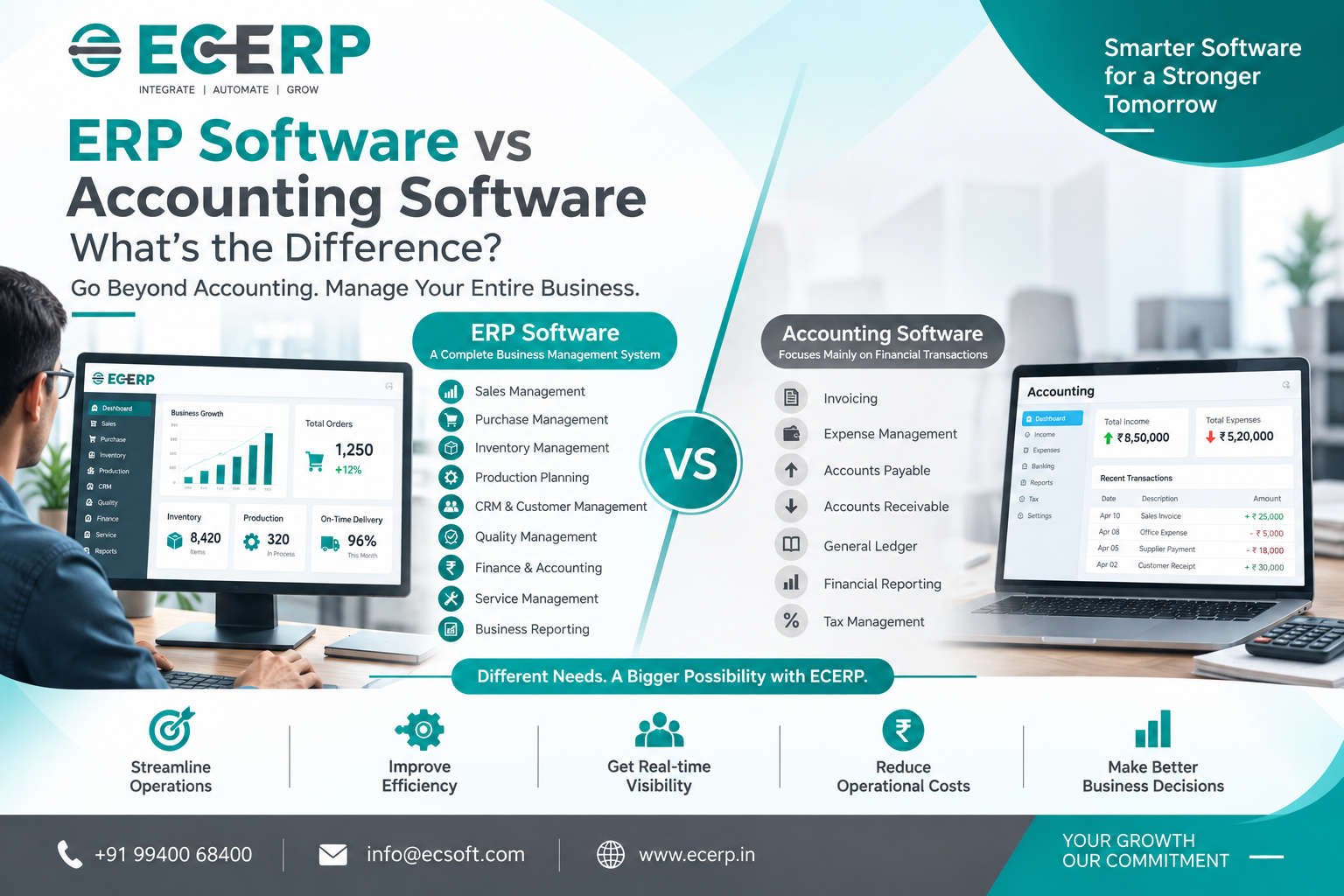
ERP Software vs Accounting Software: What’s the Difference?
If your business is growing, you may eventually face an important software decision: Is accounting software enough, or do you need a complete ERP system? At first, the difference may not seem significant. Both systems can handle financial transactions, invoices, payments and business records. But they solve very different problems.
Accounting software primarily focuses on managing financial transactions and accounts. ERP software goes much further by connecting finance with sales, purchasing, inventory, production, CRM, services and other business operations. That distinction becomes increasingly important as a company grows.
A business may start with accounting software because it needs to create invoices, record expenses and manage accounts. But when employees begin using separate spreadsheets and applications for inventory, sales, purchasing, production and customer information, managing the business becomes more complicated.
This is where ERP Software can make a significant difference.
ERP Software vs Accounting Software: The Short Answer
The simplest way to understand the difference is:
Accounting software manages the financial side of a business, while ERP software connects financial and operational processes across the entire organization.
Accounting software typically focuses on:
- Invoicing
- Payments
- Receipts
- Expenses
- General ledger
- Accounts payable
- Accounts receivable
- Financial reports
- Tax-related accounting
An ERP system can include these financial functions while also managing:
- Sales
- Purchase
- Inventory
- Warehouses
- Production
- Planning
- Quality
- CRM
- Service
- Finance
- Business reporting
So, ERP isn't necessarily a replacement for accounting—it is a broader business management system that can include accounting as one of its core functions.
What is Accounting Software?
Accounting software is designed primarily to help businesses record, organize and manage financial transactions.
For example, a company may use accounting software to:
- Create invoices
- Record customer payments
- Track expenses
- Manage receivables
- Manage payables
- Reconcile transactions
- Maintain financial records
- Generate accounting reports
- Manage tax-related financial information
For a small business with relatively simple operations, this may be everything it needs.
If the primary requirement is financial accounting, a dedicated accounting solution can be practical and cost-effective.
The challenge begins when the business needs to manage much more than financial transactions.
What is ERP Software?
Instead of managing each function separately, ERP connects the flow of information across the organization.
For example:
Customer Order
Sales
Planning
Purchase
Inventory
Production
Quality
Finished Goods
Dispatch
Finance
This connected approach allows departments to work with shared business information.
That is one of the fundamental differences between ERP software and accounting software.
ERP vs Accounting Software: Key Differences
The difference becomes much clearer when the two systems are compared based on what they are designed to manage.
| Area | Accounting Software | ERP Software |
|---|---|---|
| Primary purpose | Financial management | Complete business management |
| Accounting | ✓ | ✓ |
| Invoicing | ✓ | ✓ |
| Payments & receipts | ✓ | ✓ |
| Sales management | Limited / varies | ✓ |
| Purchase management | Limited / varies | ✓ |
| Inventory management | Limited / varies | ✓ |
| Warehouse management | Limited / varies | ✓ |
| Production management | Usually limited | ✓ |
| Production planning | Usually limited | ✓ |
| BOM management | Usually limited | ✓ |
| Quality management | Usually limited | ✓ |
| CRM | Usually limited | ✓ |
| Service management | Usually limited | ✓ |
| Department integration | Limited | ✓ |
| Centralized operational data | Limited | ✓ |
| Business-wide reporting | Primarily financial | Financial + operational |
| Suitable for complex operations | Depends on business | Generally better suited |
The exact functionality varies by software provider, so businesses should always evaluate the actual features and workflows offered by the product.
The Biggest Difference: Scope
The most important difference between ERP software and accounting software is scope.
Accounting software asks:
“What happened financially?”
ERP software helps businesses understand:
“What is happening across the business, why is it happening and what needs to happen next?”
Consider a manufacturing company.
A customer places an order.
The accounting system may help record the invoice and payment.
But the business may also need to know:
- Is the product currently in stock?
- Do we have enough raw materials?
- Does the BOM require additional components?
- Should we create a production order?
- Do we need to purchase materials?
- Which supplier should receive the purchase order?
- What is currently being produced?
- Has quality inspection been completed?
- When will the finished goods be available?
- Can the order be dispatched?
These are operational questions.
And this is where an ERP system becomes much more valuable.
Accounting Software vs ERP: A Real Business Example
Imagine a growing furniture manufacturer.
A customer orders 100 tables.
The sales team receives the order.
The production team needs to determine the materials required.
The purchase team checks whether wood, fittings and other materials are available.
The stores team checks inventory.
Production prepares the required quantity.
Quality checks the finished products.
The dispatch team prepares delivery.
Finance raises the invoice and records the payment.
With disconnected software, each department may maintain its own records.
With an integrated ERP system, these activities can become part of one connected business process.
The difference is not simply software functionality.
It is information flow.
When information moves smoothly between departments, employees don't have to repeatedly ask:
“What is the current status?”
That can make a significant difference to day-to-day operations.
When is Accounting Software Enough?
Accounting software may be sufficient when your business:
- Has relatively simple operations
- Primarily needs financial management
- Has limited inventory requirements
- Does not have complex production
- Has few operational departments
- Does not need extensive workflow automation
- Can manage operational information separately without major problems
For a small service business, consultant or early-stage company, accounting software may be perfectly adequate.
There is no advantage in implementing a large ERP system simply because ERP has more features.
The right software is the software that solves the business's actual problems.
When Should a Business Consider ERP Software?
A business should consider moving toward ERP when operational complexity starts affecting productivity, visibility or decision-making.
Some common signs include:
- Your business has outgrown spreadsheets.
- Sales and inventory information don't match.
- Purchase teams don't have clear visibility into requirements.
- Inventory information is difficult to verify.
- Production planning is mostly manual.
- Different departments maintain separate databases.
- Management spends too much time collecting reports.
- Employees repeatedly enter the same information.
- Customer information is spread across multiple systems.
- Work orders are difficult to track.
- Multiple warehouses are becoming difficult to manage.
- Business growth is creating more operational complexity.
These aren't simply software problems.
They are business-process problems.
ERP can help address them by connecting the processes behind the information.
ERP Software vs Accounting Software for Manufacturing
For manufacturing companies, the difference can be particularly significant.
Accounting software can help manage the financial side of manufacturing.
But manufacturing itself involves many operational processes.
A manufacturer may need:
Production Planning
What needs to be produced and when?
BOM Management
What materials and components are required?
Material Requirements
What is available and what needs to be purchased?
Inventory Management
What raw materials, work-in-progress and finished goods are available?
Purchase Management
Which materials need to be ordered from suppliers?
Work Orders
Which manufacturing jobs are pending or in progress?
Quality Management
Have incoming materials and finished goods passed inspection?
Finished Goods
What has been completed and is ready for dispatch?
Finance
What are the financial transactions associated with these operations?
An integrated manufacturing ERP system can connect these activities.
That is why manufacturing companies often need more than accounting software as they grow.
ERP vs Accounting Software for Inventory Management
Inventory is another major area where the distinction becomes important.
Accounting software may record the financial value of inventory.
But operational inventory management can require much more information.
Businesses may need to know:
- What items are available?
- Where are they stored?
- What quantity is available?
- What has been received?
- What has been issued?
- What has been reserved?
- What needs to be purchased?
- What is required for production?
- Which warehouse holds the stock?
An ERP system can connect inventory with sales, purchasing, production and finance.
This provides a much broader view of inventory than simply recording its financial value.
ERP vs Accounting Software for Sales
Accounting software is usually focused on the financial transaction created by a sale.
ERP software can connect the complete sales process.
For example:
Lead → Customer → Quotation → Sales Order → Inventory → Delivery → Invoice → Payment
This gives businesses greater visibility from customer enquiry through revenue collection.
For companies with active sales teams, multiple products or complex order fulfillment, this connected process can be extremely valuable.
ERP vs Accounting Software for Purchasing
Purchasing is another area where ERP can provide broader control.
Instead of simply recording supplier invoices, an ERP system can connect:
Purchase Requirement → Supplier → Purchase Order → Material Receipt → Inventory → Invoice → Payment
This creates a clearer relationship between procurement and actual business requirements.
For growing businesses, this can help reduce unnecessary purchasing and improve coordination between purchase, stores and finance teams.
ERP vs Accounting Software for Business Reporting
Accounting software primarily provides financial visibility.
ERP can combine financial information with operational information.
Management may want to know:
- Sales performance
- Purchase value
- Inventory position
- Production status
- Customer activity
- Pending orders
- Supplier performance
- Quality results
- Service activity
- Financial performance
This creates a more complete picture of the organization.
Instead of asking multiple departments for separate reports, management can work from connected business information.
Can ERP Software Replace Accounting Software?
In many cases, yes—but it depends on the ERP platform.
Some ERP systems include comprehensive finance and accounting functionality, while others integrate with external accounting applications.
Before replacing an existing accounting system, businesses should check whether the ERP supports their required accounting workflows, statutory requirements, reports, integrations and financial controls.
The important point is:
ERP and accounting software are not necessarily competing categories.
Accounting can be a core part of ERP.
ERP simply extends beyond accounting into operational management.
Can a Small Business Use ERP Software?
Yes.
ERP is not only for large enterprises.
Small and medium-sized businesses can use ERP software when they need to connect multiple business functions.
However, a small company should avoid choosing an ERP simply because it has a large number of modules.
Instead, evaluate:
- Current business requirements
- Number of users
- Operational complexity
- Required modules
- Ease of use
- Implementation process
- Scalability
- Integration requirements
- Support
- Total cost
For a growing business, an ERP system can provide a structured foundation without waiting until operational problems become difficult to control.
ERP or Accounting Software: Which One Should You Choose?
There is no universal answer.
Use this simple decision framework.
Choose Accounting Software If:
Your primary requirement is:
Finance + Accounting + Invoicing + Payments + Financial Reporting
and your operational processes are relatively simple.
Consider ERP Software If:
Your business needs:
Finance + Sales + Purchase + Inventory + Production + Planning + CRM + Quality + Service + Business Reporting
within a connected environment.
The decision should be based on business complexity rather than company size alone.
A small manufacturing company with complex inventory and production may benefit from ERP earlier than a larger consultancy with relatively simple operations.
ERP vs Accounting Software: What About Cost?
One common reason businesses hesitate to consider ERP is cost.
ERP software can require a larger investment than basic accounting software because it may involve:
- More modules
- More users
- Implementation
- Data migration
- Training
- Customization
- Integrations
- Support
However, comparing only the software price can give an incomplete picture.
Businesses should also consider the cost of:
- Manual data entry
- Duplicate work
- Inventory errors
- Production delays
- Poor purchasing decisions
- Reporting delays
- Disconnected systems
- Lost business opportunities
The better question is not:
“Which software is cheaper?”
It is:
“Which solution provides the right value for our business requirements?”
Why Growing Businesses Move From Accounting Software to ERP
Many businesses don't start with ERP.
They start with accounting software because their initial requirements are straightforward.
As the company grows, however, new processes appear.
More customers.
More products.
More employees.
More suppliers.
More inventory.
More orders.
More warehouses.
More operational decisions.
Eventually, the accounting system remains important—but it is no longer enough to manage the whole business.
This is often the point where companies begin evaluating ERP software for growing businesses.
The move isn't necessarily about abandoning accounting.
It is about connecting accounting with everything that happens before and around the financial transaction.
A Simple Way to Remember the Difference
Think about a restaurant.
Accounting software can tell you:
How much money came in and went out.
ERP can help you understand:
What was sold, what ingredients were purchased, what inventory was consumed, what suppliers were used, what customers ordered, what operations were performed and how those activities affected the financial results.
In simple terms:
Accounting tells you about the money. ERP helps you manage the business that generates the money.
That is the difference.
Why Integrated ERP Software Can Be Better for Growing Businesses
Growth creates complexity.
If every new process requires another spreadsheet or application, businesses can quickly end up with disconnected information.
An integrated ERP system can bring important functions together:
CRM
Customer relationships and enquiries.
Sales
Quotations and sales orders.
Purchase
Suppliers and procurement.
Stores
Inventory and warehouses.
Planning
Demand and resource planning.
Production
Manufacturing operations.
Quality
Inspection and quality processes.
Finance
Financial transactions and reporting.
Service
Customer service and support.
This connected structure helps the organization operate as one business rather than as a collection of separate departments.
What Should you Check Before Buying ERP Software?
If you have decided that accounting software is no longer enough, don't immediately choose an ERP based on a feature list.
Ask these questions first:
Does it support my business processes?
The software should fit your actual workflow.
Can departments share information?
Sales, purchase, inventory, production and finance should not operate as isolated systems.
Is the system scalable?
Your ERP should support future growth.
Is it easy for employees to use?
Adoption is critical to ERP success.
Can existing data be migrated?
Ask how customer, supplier, item, inventory and financial data will be handled.
What implementation support is provided?
Understand training, configuration, migration and technical support.
What integrations are available?
Check whether the ERP can connect with the other systems your business needs.
What is the total cost?
Consider implementation, customization, training, support and future expansion—not only the license or subscription price.
ERP Software vs Accounting Software: Comparison at a Glance
| Business Requirement | Accounting Software | ERP Software |
|---|---|---|
| Financial accounting | ✓ | ✓ |
| Invoicing | ✓ | ✓ |
| Receipts & payments | ✓ | ✓ |
| Expense management | ✓ | ✓ |
| Sales management | Limited | ✓ |
| Customer management | Limited | ✓ |
| Purchase management | Limited | ✓ |
| Inventory management | Limited | ✓ |
| Warehouse management | Limited | ✓ |
| Production | Usually limited | ✓ |
| Production planning | Usually limited | ✓ |
| BOM | Usually limited | ✓ |
| Quality | Usually limited | ✓ |
| Service management | Limited | ✓ |
| Cross-department workflow | Limited | ✓ |
| Operational reporting | Limited | ✓ |
| Business-wide visibility | Limited | ✓ |
The key isn't that ERP is always better.
The key is that ERP is designed to manage a broader range of connected business processes.
Frequently Asked Questions About ERP vs Accounting Software
What is the difference between ERP and accounting software?
Accounting software primarily manages financial transactions and accounting processes. ERP software manages accounting along with other business functions such as sales, purchasing, inventory, production, CRM, quality and service.
Is ERP software the same as accounting software?
No. Accounting is usually one part of an ERP system. ERP covers a much broader range of business processes and connects them within an integrated system.
Do I need ERP software if I already have accounting software?
Not necessarily. If your business only needs accounting and financial management, accounting software may be sufficient. If your business has complex sales, inventory, purchasing, production, service or multi-department processes, ERP may be more appropriate.
Can ERP software handle accounting?
Yes. Many ERP systems include accounting and financial management capabilities. However, the exact accounting functionality varies by ERP provider.
Is ERP better than accounting software?
Neither is universally better. Accounting software can be the right choice for businesses with straightforward financial requirements. ERP is generally more suitable when a business needs to connect multiple operational and financial processes.
When should a small business move from accounting software to ERP?
A business should consider ERP when growth creates operational complexity, such as increasing inventory, multiple warehouses, production requirements, growing sales teams, disconnected spreadsheets or difficulty coordinating departments.
Can ERP software manage inventory?
Yes. Many ERP systems provide inventory and warehouse management capabilities and can connect inventory with sales, purchase, production and finance.
Can ERP software be used by manufacturing companies?
Yes. Manufacturing ERP software can connect production planning, BOM, purchasing, inventory, work orders, quality, sales and finance.
Is ERP software expensive compared with accounting software?
ERP can cost more because it often covers more business functions and may require implementation, training, customization and integrations. Businesses should compare total cost against the operational value the system provides.
What is the main benefit of ERP over accounting software?
The biggest advantage is integration. ERP connects departments and business processes so that information can flow through the organization instead of remaining in separate systems.
Why Choose ECERP Instead of Managing Separate Business Systems?
Managing your business shouldn't require employees to constantly move information between different applications.
ECERP brings key business functions into one connected ERP environment, including:
- CRM
- Sales
- Purchase
- Stores
- Planning
- Production
- Quality
- Finance
- Service
This allows businesses to connect the journey from customer requirement to business transaction within a unified system.
For example:
Customer Enquiry
→ Quotation
→ Sales Order
→ Planning
→ Purchase
→ Inventory
→ Production
→ Quality
→ Finished Goods
→ Invoice
→ Payment
Instead of treating each stage as a separate activity, an integrated ERP approach allows businesses to manage the complete process with connected information.
Is Your Accounting Software Still Enough?
If your business is small and your primary requirement is accounting, it may be.
But if your team is constantly asking:
“Where is the stock?”
“Has the purchase order been received?”
“What is the production status?”
“Which orders are pending?”
“What materials do we need?”
“What is happening with this customer?”
“Why are these reports different?”
then your challenge may no longer be accounting.
It may be business integration.
That's when it makes sense to evaluate ERP software.
Ready to Move Beyond Accounting Software?
Your accounting system tells an important part of your business story.
But as your business grows, you may need visibility into the processes that create those financial results.
If your business has outgrown spreadsheets and disconnected applications, now may be the right time to evaluate a complete ERP software solution for your business.
Explore ECERP →
See how an integrated ERP system can help your business connect operations, improve visibility and manage growth more effectively.
Make the move from disconnected processes to connected business management.
Final Takeaway
The difference between ERP software and accounting software comes down to scope and integration.
Accounting software focuses primarily on financial management.
ERP software connects finance with the wider business.
If your company only needs accounting, a dedicated accounting system may be enough.
But if you need to connect sales, purchasing, inventory, production, planning, quality, CRM, service and finance, an ERP system can provide a much more complete view of your business.
The right time to consider ERP isn't simply when your company reaches a certain number of employees.
It is when business complexity starts making disconnected systems difficult to manage.
Start by identifying where information gets lost, where teams duplicate work and where management lacks visibility.
Then choose an ERP system that solves those problems—and can continue supporting your business as it grows.